
DR HAROLD MANDEL DAILY ROUNDS
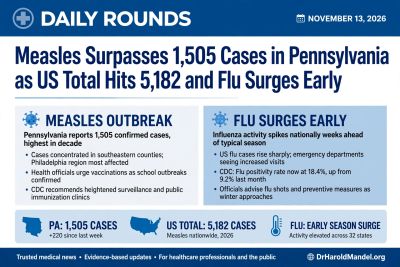
Daily Rounds - November 13, 2026: Pennsylvania Measles Surpasses 1,505 Cases in 45 Counties as US Total Hits 5,182 and Flu Surges Early
Pennsylvania Department of Health announced 1,505 confirmed measles cases across 45 counties as of November 9, up 18 from its previous update Friday, November 6, with 73 new cases in the past seven days. CDC reported 5,182 confirmed measles cases nationwide as of November 5, updated November 6 — the highest annual total since 1991 and more than double the 2,289 cases in all of 2025. Flu hospitalizations hit 8,396 admissions in the week ending October 31, up 38%.
What Causes It
Measles is caused by measles virus, one of the most contagious viruses known, able to live in airspace up to two hours after an infected person leaves. It was eliminated from the US in 2000 but has returned. Flu this season is driven almost entirely by influenza A(H1N1)pdm09 with 99.2% of subtyped viruses through late October reported as H1N1.
How It Spreads
- Measles: Airborne when infected person coughs or sneezes. Up to 9 of 10 unvaccinated close contacts become infected. CDC reports 5,164 cases by 47 jurisdictions plus 18 international visitors, 96% outbreak-associated with 43 outbreaks, 562 hospitalizations (11%). Only five states with no reported cases.
- Flu: Respiratory droplets, close contact within 6 feet, contaminated surfaces. CDC Week 43 ending Oct 31 reported clinical lab positivity 9.1% of respiratory specimens, up from earlier weeks. Flu accounted for 1.7% of emergency department visits, up 42% in one week from 1.2%. CDC says flu is growing or likely growing in 44 states, nearly a month ahead of typical season.
Prevention
- MMR vaccine is best protection for measles: two doses about 97% effective, one dose about 93% effective. Less than 1% of Pennsylvania cases were among vaccinated individuals. Pennsylvania reports 6 deaths, 290 hospitalized, 45 counties hit as of Nov 9 per state data. Children: first dose 12-15 months, second 4-6 years. Adults with two documented doses generally protected for life.
- Flu vaccine: CDC recommends annual flu vaccine for everyone 6 months and older, ideally September or October. For adults 65+, high-dose, recombinant, or adjuvanted vaccine preferred. CDC estimates at least 1.7 million illnesses, 25,000 hospitalizations, and 1,400 deaths from flu so far this season, including first pediatric flu death of the season reported in Week 42.
- Everyday actions: stay home when sick, cover coughs and sneezes, wash hands often, improve ventilation, avoid touching face, call ahead if you suspect measles.
Current Recommendations - November 12, 2026
- National measles: 5,182 cases as of Nov 5 per CDC Nov 6 update, up 330 cases (6.8%) from prior week — 13th straight week of triple-digit increases. CDC table lists four deaths, state-level data indicates eight per ABC News. Pan American Health Organization regional commission met Nov 10-13 to review US elimination status, which requires 12 months without sustained transmission.
- Pennsylvania: 1,505 cases as of Nov 9 per PA DOH and Reuters, up 18 since Nov 6, 73 new in past 7 days, 6 dead, 290 hospitalized, 45 counties. Bucks County now reporting cases as outbreak hits two-thirds of state. PA has highest total in US, followed by South Carolina 670 and Utah 536.
- Flu: CDC FluView Week 43 reported 8,396 lab-confirmed admissions, up 38% from 6,100 prior week. FluSurv-NET estimated true weekly rate 1.9-2.5 per 100,000 after delays, highest Week 42-43 since 2010-11 season. Forecasts predict 6,900 to 30,100 new lab-confirmed admissions likely in week ending Nov 21, with likely increase nationally.
- Check MMR status now and flu vaccination before travel, school events, and gatherings.
When to Seek Care
For measles: fever, cough, runny nose, red eyes, rash 7-21 days after exposure. For flu: trouble breathing, persistent chest pain, confusion, inability to keep fluids down, or symptoms that improve then return with fever and worse cough. Antivirals work best within 2 days, especially for high-risk groups. Call ahead if you suspect measles to prevent spread.
Sources: CDC Measles Cases and Outbreaks updated November 6, 2026 as of Nov 5 with 5,182 cases; Pennsylvania Department of Health Provides Statewide Update as Cases Reach 1,505 in 45 Counties Nov 9, 2026 with 18 new since Nov 6, 73 in past 7 days; Reuters Pennsylvania measles cases surpass 1,500 Nov 9; CDC Weekly US Influenza Surveillance Report Week 43 ending Oct 31 with 8,396 admissions up 38%; Becker's Hospital Review Flu ED visits up 42% to 1.7% Nov 6; CDC Forecasts of Flu Hospital Admissions as of Nov 4 with 6,900 to 30,100 projection for week ending Nov 21.
Educational purposes only, not medical advice. Talk with your clinician.
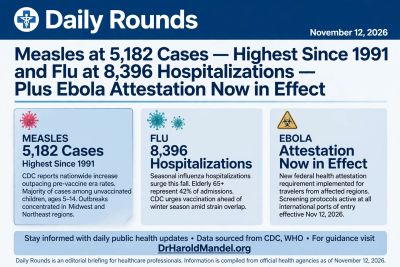
Daily Rounds - November 12, 2026: Measles at 5,182 Cases Highest Since 1991 and Flu at 8,396 Hospitalizations Plus Ebola Attestation Now in Effect
By Dr. Harold Mandel | November 12, 2026 | DrHaroldMandel.org / MandelNews.com
CDC reported three major updates as of November 6: measles rose to 5,182 confirmed cases nationwide as of November 5, the highest annual total since 1991 and more than double the 2,289 total from all of 2025. Flu hospitalizations rose to 8,396 lab-confirmed admissions in the week ending October 31, up 38% from 6,100 the prior week. Ebola attestation rule for all US-bound air travelers took effect November 3 at 11:59 p.m. EST.
What Causes It
Measles is caused by measles virus, one of the most contagious viruses known, able to live in airspace up to two hours after an infected person leaves. It was eliminated from the US in 2000 but has returned. CDC reports 5,182 cases include 5,164 by 47 jurisdictions plus 18 international visitors.
Flu is caused by influenza viruses. This season 99.2% of subtyped A viruses were A(H1N1), with early surge highest since 2010-2011 for this calendar week. CDC estimates at least 1.7 million illnesses, 25,000 hospitalizations, and 1,400 deaths from flu so far this season, including first pediatric flu death.
Ebola in this DRC outbreak is caused by Bundibugyo virus, the 17th outbreak in DRC and second-largest on record. Not spread through air, water, or food.
How It Spreads
Measles: Airborne when infected person coughs or sneezes. Up to 9 of 10 unvaccinated close contacts become infected. CDC reports 96% of cases are outbreak-associated across 43 outbreaks in 45 states plus DC. Only five states with no cases: Arkansas, Hawaii, Mississippi, Nevada, New Hampshire.
Flu: Respiratory droplets, close contact within 6 feet, contaminated surfaces. Flu accounted for 1.7% of emergency department visits week ending Oct 31, up 42% in one week. CDC says flu is growing or likely growing in 44 states. FluSurv-NET weekly hospitalization rate estimated 1.9 to 2.5 per 100,000 after accounting for delays — highest Week 43 since 2010-11.
Ebola: Direct contact with blood, vomit, diarrhea, other body fluids, contaminated bedding, bodies of deceased. Incubation 2 to 21 days.
Prevention
MMR vaccine is best protection for measles: two doses about 97% effective, one dose about 93% effective. Less than 1% of Pennsylvania cases were among vaccinated individuals. Children: first dose 12-15 months, second 4-6 years. Adults with two documented doses generally protected for life.
Flu vaccine: Annual flu vaccine for everyone 6 months and older, ideally September or October. For 65+, high-dose, recombinant, or adjuvanted vaccine preferred. Everyday actions: stay home when sick, cover coughs and sneezes, wash hands often, improve ventilation.
Ebola attestation: Since 11:59 p.m. EST Nov 3, all passengers boarding any international flight to US must sign attestation they have not been in Democratic Republic of Congo in past 21 days. Order through Dec 18, 2026 unless extended. Airlines must collect and retain for 42 days. No attestation means denied boarding.
Current Recommendations - November 11, 2026
National measles: 5,182 cases as of Nov 5 per CDC update Nov 6, up 330 cases (6.8%) from 4,852 prior week — 13th straight week of triple-digit increases. Hospitalizations 562 (11%), CDC table lists four deaths, state-level reports indicate eight. Next CDC update expected this week.
Pennsylvania remains epicenter: 1,467 cases and 283 hospitalizations as of Nov 4, up 34 in 48 hours, with sixth measles-linked death confirmed — an unvaccinated Jefferson County resident. Forty-five counties affected.
Flu: CDC FluView Week 43 ending Oct 31 reported 8,396 admissions, up 38%. FluSight forecasts predict 6,900 to 30,100 new lab-confirmed admissions likely in week ending Nov 21, with likely increase nationally. CDC estimates 1.7M illnesses, 25K hospitalizations, 1.4K deaths so far this season.
Ebola: DRC outbreak has surpassed 10,200 cases and nearly 5,000 deaths per CDC and traveler guidance updated early November. Risk to US remains low, no cases in US. All travelers should check CDC Travel Health Notices.
When to Seek Care
For measles: fever, cough, runny nose, red eyes, rash 7-21 days after exposure. For flu: trouble breathing, persistent chest pain, confusion, inability to keep fluids down, symptoms that improve then return with fever and worse cough. Antivirals work best within 2 days. For Ebola concern: fever, severe headache, muscle pain, vomiting, diarrhea, unexplained bleeding within 21 days of DRC travel — call ahead and mention travel history immediately.
Sources: CDC Measles Cases and Outbreaks updated Nov 6 with 5,182 cases as of Nov 5; Reuters US measles cases rise to 5,182 highest since 1991 Nov 6; CDC Weekly US Influenza Surveillance Report Week 43 ending Oct 31 with 8,396 admissions; Becker's Hospital Review Flu ED visits up 42% to 1.7% Nov 6; CDC Forecasts of Flu Hospital Admissions as of Nov 4 with 6,900 to 30,100 projection; CDC Ebola attestation order effective Nov 3 11:59 p.m. EST through Dec 18 via Federal Register.
Educational purposes only, not medical advice. Talk with your clinician.
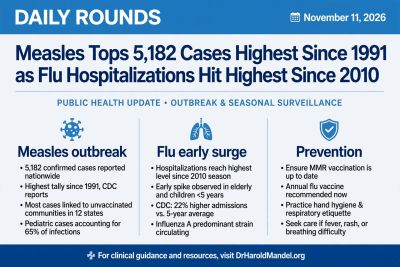
Daily Rounds - November 11, 2026: Measles Tops 5,182 Cases — Highest Since 1991 — as Flu Hospitalizations Hit Highest Since 2010
CDC's latest updates show two major trends converging: measles has reached 5,182 confirmed cases nationwide as of November 5, the highest annual total since 1991, and early flu hospitalizations have hit their highest level for this calendar week since the 2010-2011 season.
What Causes It
Measles is caused by measles virus, one of the most contagious viruses known. It was eliminated from the US in 2000 but has returned to its highest level in 35 years. Flu this season is driven almost entirely by influenza A(H1N1) with 99.2% of subtyped viruses through mid-October reported as A(H1N1).
How It Spreads
- Measles: Airborne when an infected person coughs or sneezes. Virus can live in airspace up to two hours after person leaves. Up to 9 of 10 unvaccinated close contacts become infected. CDC reports 96% of current cases are outbreak-associated across 43 outbreaks, now in 45 states plus DC.
- Flu: Respiratory droplets, close contact within 6 feet, contaminated surfaces. CDC FluView Week 43 ending Oct 31 reported 8,396 lab-confirmed flu admissions, up 38% from prior week. Flu accounted for 1.7% of emergency department visits, up 42% in one week. CDC says flu is growing or likely growing in 44 states.
Prevention
- MMR vaccine is best protection for measles: two doses about 97% effective, one dose about 93% effective. Less than 1% of Pennsylvania cases were among vaccinated individuals. Children: first dose 12-15 months, second 4-6 years. Adults with two documented doses generally protected for life.
- Flu vaccine: CDC recommends annual flu vaccine for everyone 6 months and older, ideally September or October. For adults 65+, high-dose, recombinant, or adjuvanted vaccine preferred. CDC estimates at least 1.7 million illnesses, 25,000 hospitalizations, and 1,400 deaths from flu so far this season, including first pediatric flu death reported.
- Everyday actions: stay home when sick, cover coughs and sneezes, wash hands often, improve ventilation, avoid touching face, call ahead if you suspect measles.
Current Recommendations - November 6, 2026
- National measles: 5,182 cases as of Nov 5 per CDC update Nov 6, up 330 cases (6.8%) from 4,852 prior week — the 13th straight week of triple-digit increases. Includes 5,164 cases reported by 47 jurisdictions plus 18 international visitors. Hospitalizations 562 (11%), CDC table lists four deaths for 2026, though state-level data indicates eight per ABC News reporting. Pan American Health Organization is set to review US elimination status Nov 10.
- Pennsylvania remains epicenter: 1,467 cases and 283 hospitalizations as of Nov 4, up 34 in 48 hours, with sixth measles-linked death confirmed — an unvaccinated Jefferson County resident. Forty-five counties affected.
- Flu: Hospitalization rate for Week 42-43 is highest for this time since 2010-11 per FluSurv-NET, which covers about 10% of US population. CDC estimates true weekly rate 1.9 to 2.5 per 100,000 after delays. Cumulative rate 2.1 per 100,000, more than 10 times same period last season. FluSight forecasts project 6,900 to 30,100 new admissions likely week ending Nov 21, with likely increase nationally.
- Check MMR status now and flu vaccination before travel, school events, and gatherings. Coverage for children dropped to about 50% last year vs over 60% in 2019-2020.
When to Seek Care
For measles: high fever, cough, runny nose, red eyes, rash 7-21 days after exposure. For flu: trouble breathing, persistent chest pain, confusion, inability to keep fluids down, or symptoms that improve then return with fever and worse cough. Antivirals work best within 2 days, especially for high-risk groups. Seek prompt care for trouble breathing, dehydration, or confusion.
Sources: CDC Measles Cases and Outbreaks updated November 6, 2026 as of Nov 5 with 5,182 cases; Reuters US measles cases surge to 5,182 highest in 35 years Nov 6; Becker's Hospital Review Flu ED visits up 42% to 1.7% with 8,396 admissions up 38%; CDC FluView Week 43; CDC Forecasts of Flu Hospital Admissions as of Oct 28 with 6,900 to 30,100 projection.
Educational purposes only, not medical advice. Talk with your clinician.