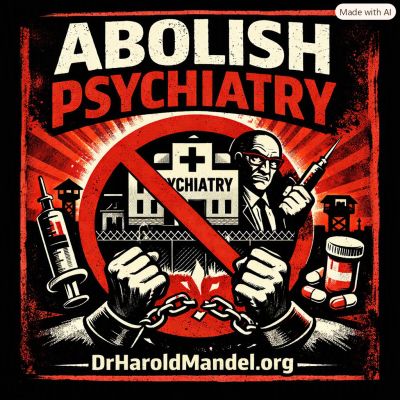
DrHaroldMandel.org/MandelNews.com Antipsychiatry Medical Heretic
Saturday April 11, 2026
Independent Natural Mental Healthcare and
Human Rights Advocacy for Whole‑Person Wellness
DrHaroldMandel.org/MandelNews.com Antipsychiatry Medical Heretic
Independent Natural Mental Healthcare and
Human Rights Advocacy for Whole‑Person Wellness
Your Donation Empowers Wellness
Your Contribution Defends Human Rights


I am a New York-based physician, medical journalist, and fiction writer. My work is defined by a lifelong commitment to medical advocacy—defending the individual against coercive systems and corporate influence. Currently, I focus my professional efforts on three critical pillars:

Transform your life at Rythmia, Costa Rica! Enjoy Ayahuasca ceremonies, organic farm-to-table food, volcanic mud baths, and luxury wellness at the world’s first medically-licensed plant medicine center. 🌿✨ Click this link to learn more about Rythmia and to schedule a free info session>>> Rythmia: World's First Medically Licensed Ayahuasca Retreat

A tossed salad may look humble, but it delivers a quiet, whole‑person boost that few foods can match. Fresh greens, crisp vegetables, and a drizzle of clean dressing create a harmony of nutrients that support you on every level.
For the body, a salad is a direct infusion of vitamins, minerals, fiber, and antioxidants. Leafy greens strength
A tossed salad may look humble, but it delivers a quiet, whole‑person boost that few foods can match. Fresh greens, crisp vegetables, and a drizzle of clean dressing create a harmony of nutrients that support you on every level.
For the body, a salad is a direct infusion of vitamins, minerals, fiber, and antioxidants. Leafy greens strengthen the heart, colorful vegetables protect cells from inflammation, and fiber steadies digestion and blood sugar. It’s nourishment that feels light yet sustaining.
For the mind, the nutrients in vegetables — especially folate, magnesium, and plant antioxidants — help support focus, memory, and emotional balance. A salad’s steady energy prevents the mental fog that follows heavier meals, keeping your thinking clear and calm.
For the spirit, preparing and eating a tossed salad is an act of mindful simplicity. The colors, textures, and freshness reconnect you with nature’s rhythms. Each bite is a reminder that caring for yourself doesn’t have to be complicated — it can be as gentle as choosing whole, living foods that make you feel grounded and renewed.
A tossed salad is more than a meal. It’s a daily ritual of wellness for body, mind, and spirit — crisp, colorful, and deeply restorative.

.


Dr. Johnathan was a man forged in the crucible of hard work and unyielding idealism. Unlike the scions of privilege who occupied the reserved seats of medical school through million-dollar legacies and alumni connections, Johnathan had clawed his way into the profession as a true outsider. He believed in the sanctity of the Hippocratic Oa
Dr. Johnathan was a man forged in the crucible of hard work and unyielding idealism. Unlike the scions of privilege who occupied the reserved seats of medical school through million-dollar legacies and alumni connections, Johnathan had clawed his way into the profession as a true outsider. He believed in the sanctity of the Hippocratic Oath and the inherent justice of the medical system. Having just completed an impressive internship, he stood on the precipice of a brilliant career, unaware that his greatest enemy was not a disease, but the man who had given him life.
His father, Jack, was a high-functioning Wall Street broker whose soul was as hollowed out by greed as it was by the “herd drinking” culture of his peers. Jack’s world was one of cocktail parties and rigid social hierarchies, a world where he viewed his son’s partner—a stunning Asian woman from San Francisco—not as a person, but as “the Thing.” In a chilling revelation of character, Jack’s deep-seated racism emerged, mirroring the virulent prejudice of the KKK. He threatened to disinherit Johnathan and ruin his career unless he purged this “embarrassment” from his life. Johnathan, naively clinging to the hope that his father’s vitriol was merely the product of a Nembutal-induced haze, agreed to see a psychiatrist at Jack’s suggestion to “work out his problems.”
It was the ultimate betrayal. Jack, leveraging his influence and the inherent biases of a system designed to control rather than cure, orchestrated a “diagnosis” over the phone. Without a fair evaluation, Johnathan was labeled with late-onset schizophrenia and bipolar disorder. The very profession he had sacrificed everything to join became his jailer. He was railroaded into mental institutions, his mind clouded by heavy doses of psychotropic drugs that stripped him of his agency and his dignity.
While Johnathan languished in the gray corridors of institutionalization, Jack moved to erase his son’s life entirely. He arranged for a wealthy, traditionalist radiologist to “woo” Johnathan’s girlfriend away with the hollow glitter of fur coats and diamonds, ensuring that the life Johnathan had built was dismantled piece by piece. Stigmatized and marginalized, Johnathan became a ghost on the fringes of existence, a victim of intentional psychiatric weaponization.
The end came in the darkness of a psychiatric ward. Dr. Johnathan was brutally beaten and raped to death by the very staff—the psychiatrists and nurses—who were sworn to protect the vulnerable. The official report, a final act of institutional cowardice, blamed the other patients. When the news reached the family estate, Jack sat with his wife, Francis, and sipped a cocktail. With a cold, clinical indifference, he remarked that his son had simply gotten “what was coming to him.” In Jack’s America, there was no room for idealism, only the brutal maintenance of the status quo.
LEGAL NOTICE: This story is a work of total fiction. It is a cautionary fable, set in a highly exaggerated and dark vision of the future that has no basis in current reality. The events, laws, and characters described are entirely imaginary products of the author's mind and are intended for creative exploration and entertainment only. Copyright © 2026 Dr. Harold Mandel. All Rights Reserved.

.

Psychiatry, a field presented as dedicated to promoting mental well-being, has a well-documented history of being co-opted for social control and financial exploitation. This commentary contends that narratives blaming career setbacks and financial hardships on an individual’s inherent mental illness—particularly among activists and whist
Psychiatry, a field presented as dedicated to promoting mental well-being, has a well-documented history of being co-opted for social control and financial exploitation. This commentary contends that narratives blaming career setbacks and financial hardships on an individual’s inherent mental illness—particularly among activists and whistleblowers—often reverse cause and effect. In reality, deliberate stigmatization and pathologization generate the severe stress, financial devastation, and professional ruin that are then cited as “proof” of mental instability.
The Mechanisms of Psychiatric Oppression
Weaponizing psychiatry against targeted individuals relies on several calculated tactics that systematically dismantle lives and silence dissent.
First, assigning labels like “mentally unstable” or fabricating severe diagnoses discredits the person’s claims and erodes their credibility. A whistleblower’s allegations of wrongdoing, for example, can be reframed as delusions stemming from a disordered mind, allowing organizations to dismiss legitimate concerns without scrutiny.
Second, this stigmatization frequently results in job loss or blocked opportunities. “Fitness-for-duty” evaluations, often mandated in professional settings, can be manipulated to justify termination. Once applied, a psychiatric label functions as enduring blacklisting, particularly in roles demanding trust, responsibility, or public engagement. The individual becomes a professional and social outcast, with support networks fracturing under the pressure.
Third, the relentless assault on reputation and livelihood triggers profound financial collapse. Legal costs from defending against unfounded accusations, combined with lost income and barriers to re-employment, create a downward spiral of impoverishment. This engineered dependency weakens resistance and breaks the spirit.
Most insidiously, the natural stress responses—anxiety, depression, and emotional distress—arising from such persecution are then interpreted as symptoms of underlying mental illness. This self-fulfilling prophecy justifies escalated intervention and control, trapping victims in a vicious cycle that can persist indefinitely.
Historical and Contemporary Examples
The misuse of psychiatry for suppression is far from new. Authoritarian regimes have long employed it to neutralize threats to power.
In the Soviet Union, political dissidents were routinely institutionalized with invented diagnoses such as “sluggish schizophrenia,” which pathologized “anti-Soviet thinking” or “delusions of reformism.” This allowed the regime to incarcerate and discredit opponents without overt political trials.
In 19th-century America, psychiatry rationalized slavery through pseudoscientific inventions like “drapetomania”—a supposed mental illness afflicting enslaved people who sought freedom, framing escape attempts as pathological rather than rational responses to oppression.
Today, while large-scale institutionalization of dissidents is less overt in many societies, subtler forms endure. Whistleblowers in corporations or government agencies often encounter retaliatory psychiatric evaluations designed to undermine them. Activists confronting entrenched interests face smear campaigns that question their mental soundness, eroding public support and resources. The goal remains consistent: to neutralize threats by attacking credibility and financial independence.
Toward Humane Alternatives
Emotional challenges are a universal part of human life, yet they need not inevitably lead to career destruction or financial ruin. When addressed with empathy, understanding, and holistic support—rather than punitive labeling—such difficulties can be navigated constructively.
The real danger lies when psychiatry is twisted into a mechanism of breakdown instead of healing. By pathologizing dissent and normal reactions to injustice, it perpetuates cycles of abuse that destroy opportunities and lives. Recognizing and resisting these tactics is essential to protecting individual rights and fostering genuine mental and social well-being.

.


Legal Warning / Age Restriction Notice
Intended Audience – Adults Only
This website (DrHaroldMandel.org / MandelNews.com) and all associated social media platforms, pages, channels, and accounts are intended exclusively for adults 18 years of age and older.
Dr. Harold Mandel is a licensed physician who provides mental healthcare advocacy, commentary, articles, educational content, mental health advice, and telehealth counseling services. The content addresses difficult, controversial, and complex issues in mental healthcare. These topics may include critical analysis of treatments, policies, industry practices, personal experiences, and related debates that can be emotionally challenging, triggering, or difficult to navigate for younger individuals.
Minors under the age of 18 are not permitted to access, view, or engage with this website or any associated social media platforms.
We use cookies to analyze website traffic and optimize your website experience. By accepting our use of cookies, your data will be aggregated with all other user data.