Your generous donation will help fund MandelNews.com

MandelNews.com Human Rights Commentaries
The Cruel System in Process: Psychiatry’s Ongoing War Against the Innocent
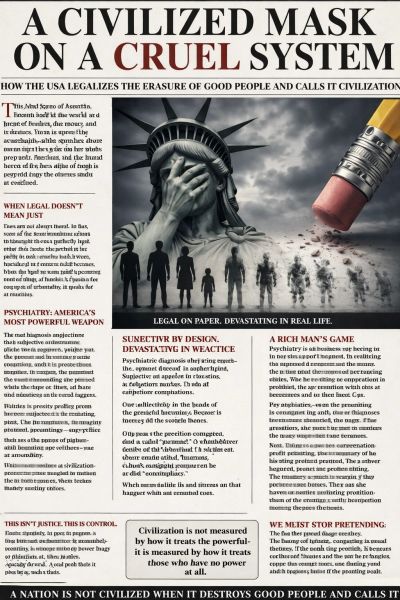
The serious issues associated with the psychiatric system as it has been woven into the American legal and financial frameworks are not hypothetical or projected—they are active, ongoing realities. At this very moment, innocent men, women, and children are being enslaved, tortured, and methodically destroyed under the guise of “mental healthcare.” This is not history—it is happening now, in real time, across the United States.
Psychiatry has become the perfect instrument of control for a society that confuses legality with morality. It operates as a seamless extension of the state and corporate power structure, legitimized by law and financed by profit. Behind the sterile language of “treatment” and “care” lies a machinery of coercion that erases individuality, autonomy, and human potential. Every forced diagnosis, every involuntary commitment, every chemical restraint is an act of violence disguised as compassion.
The tragedy is compounded by the financial incentives that sustain this cruelty. Pharmaceutical conglomerates, insurance networks, and government agencies profit from the perpetual labeling and drugging of human beings. The system rewards destruction—it thrives on dependency, not recovery. Those who oversee and fund this apparatus flourish while its victims are silenced, impoverished, and erased.
Never before in human history have so many potentially productive and worthwhile lives been wasted by a system that claims to heal. The psychiatric complex has become a national engine of human waste, converting creativity, sensitivity, and dissent into pathology. It is not a projected danger—it is a process in motion, a daily atrocity unfolding behind closed doors and beneath the veneer of civilization.
If America is to reclaim its moral compass, it must confront this reality head‑on. Civilization cannot coexist with institutional cruelty. The measure of a nation is not how it treats the powerful, but how it protects those who have no power at all.
The Bipartisan Illusion: A Mental‑Health System Designed to Disappear People, Not Help Them
The Bipartisan Illusion: A Mental‑Health System Designed to Disappear People, Not Help Them
Let’s stop pretending America is on the brink of some great mental‑health awakening. It isn’t. And it won’t be — not under Republicans, not under Democrats, not under any leadership class that depends on the psychiatric system to mop up the human wreckage of their own economic failures.
Both parties talk reform while quietly relying on psychiatry as a containment strategy. It’s the perfect pressure valve: a way to disappear the casualties of inequality without ever admitting they were produced by policy choices. The more the economy abandons people, the more the psychiatric system expands to classify them as “ill,” “unstable,” “nonfunctional,” or “beyond normalcy.”
It’s not care. It’s camouflage.
Behind the polished façades of wealthy neighborhoods — the curated calm, the manicured lawns, the illusion of national health — lies a crisis so deep that the establishment needs a mechanism to hide it. Psychiatry has become that mechanism. It takes the intentionally and unintentionally disenfranchised and relabels them as medical anomalies, not political outcomes. Once labeled, they’re removed from the statistics that measure national well‑being. They become invisible by design.
And the system has no intention of helping them back up.
There is no blueprint for wellness, stability, or reintegration. There is no investment in the humanity of the people being processed. The framework is built on management, not liberation. On sedation, not empowerment. On containment, not justice.
So even when the people caught in this system are ethical, peaceful, intelligent, compassionate, law‑abiding — even when they embody every trait society claims to value — they are still kept in the same place: down, out, poor, and sick. Not because they failed, but because the establishment needs them there to maintain the illusion that everything is fine.
This is not a broken system.
This is a system working exactly as intended.
THE PROFIT ENGINE OF US REPRESSION: HOW THE POWERFUL TURNED PSYCHIATRY INTO A WEAPONIZED MARKET
There is a truth that America’s political class hopes the public never fully grasps: the psychiatric system they champion is not a humanitarian project, not a medical necessity, and certainly not a public good. It is an economic engine, a profit‑guaranteeing machine, and a political convenience—one that the wealthy and powerful have protected for decades because it serves them far better than it serves the people.
The façade of “mental healthcare” is the marketing.
The real product is control.
Across all 50 states, the same pattern repeats: governors, legislators, judges, and entrenched bureaucrats defend a psychiatric apparatus that generates billions in revenue while stripping citizens of rights with breathtaking speed. They defend it because it is lucrative. They defend it because it is politically useful. They defend it because it creates a class of people who can be silenced, discredited, and neutralized without the messiness of constitutional protections.
And the economic incentives are staggering.
Every involuntary commitment order is a billable event.
Every forced outpatient mandate is a revenue stream.
Every “evaluation,” “risk assessment,” and “treatment plan” is a financial transaction.
Psychiatric hospitals profit.
Pharmaceutical companies profit.
Private equity firms that now own large swaths of the behavioral‑health industry profit.
And the judges and politicians who keep the conveyor belt running are rewarded with campaign donations, institutional loyalty, and the quiet elimination of people who disrupt the status quo.
The secretive psychiatric courts—those closed‑door chambers operating outside the constitutional architecture of American justice—are the perfect economic instrument. They are fast. They are opaque. They are unaccountable. And they are designed to produce one outcome: compliance with whatever the psychiatrist requests.
Two doctors speak.
A judge nods.
A life is derailed.
And the system sends out its invoices.
No jury.
No sworn testimony.
No adversarial process.
No public record that might expose the machinery.
This is not a justice system.
It is a financial pipeline disguised as law.
And once a person is pulled into this pipeline, the economic incentives ensure they are never truly free again. Forced drugging orders generate ongoing pharmaceutical revenue. Mandatory outpatient programs guarantee recurring billing. Police and federal agents enforce these civil orders as if they were criminal judgments, ensuring the individual remains trapped in a cycle of surveillance, stigma, and dependency that benefits everyone except the victim.
This is why the political elite defend psychiatry with such ferocity:
because it is profitable,
because it is politically expedient,
and because it creates a subclass of Americans who can be controlled without public scrutiny.
Meanwhile, the public goes about its day—school drop‑offs, morning coffee, office meetings—while an entire shadow system quietly expands beneath their feet. A system that destroys careers, drains bank accounts, fractures families, and pushes people into homelessness, all while generating revenue for the institutions that orchestrate the harm.
This is not a healthcare crisis.
It is an economic regime built on the bodies and futures of the vulnerable.
And until the country confronts the financial incentives that keep this machinery running, the psychiatric system will continue to function exactly as it was designed:
as a profitable instrument of social control, protected by the powerful, enforced by the state, and ignored by a public that has been taught not to look too closely.
THE EMPIRE OF CIRCUITS AND SHACKLES
HOW AMERICA TURNED PSYCHIATRY INTO A WEAPON OF SOCIAL CONTROL
The United States is a nation that can command satellites, manipulate global markets with algorithms, and engineer machines that outthink human beings—yet when it comes to understanding the human mind, it has chosen to operate with the worldview of a medieval theocracy. This is not an accident of history. It is the deliberate architecture of a country where unimaginable technological power and obscene concentrations of wealth coexist with a primitive, punitive ideology about human emotion and human difference. The richest nation in the world has built its social order around a psychiatric mythology that functions less like medicine and more like a state religion—one that demands obedience, enforces conformity, and punishes deviation with chemical and legal force.
Psychiatry’s monopoly over “mental healthcare” in the United States is not a benign professional arrangement; it is a political instrument that has been granted extraordinary authority without the scientific foundation that would justify such power. A field with no objective biological tests, no reproducible biomarkers, and no definitive diagnostic criteria has been elevated to the status of unquestionable arbiter of sanity, safety, and citizenship. And because this monopoly is woven into courts, hospitals, insurance systems, and public policy, it has become a mechanism through which the state can override autonomy, silence dissent, and reshape the boundaries of acceptable thought. To pretend this is merely healthcare is to ignore the machinery of coercion humming beneath the surface.
What are people without their healthy, non‑drugged brains? What is a society when the clarity, sovereignty, and emotional integrity of its citizens can be chemically subdued or bureaucratically pathologized? A population that doubts its own perceptions is easier to manipulate. A population taught that distress is a “chemical imbalance” rather than a rational response to inequality, trauma, or exploitation is far less likely to challenge the systems that benefit from its suffering. And a population that fears psychiatric labeling is far more likely to self‑censor, comply, and retreat from activism. This is not accidental collateral damage—it is the quiet logic of a system that uses medicine as a mask for control.
The United States, despite its technological brilliance, has allowed its laws, institutions, and investment structures to harden into a psychiatric police state. Surveillance is reframed as “monitoring.” Coercion is reframed as “treatment.” Social suffering is reframed as “disorder.” And the public, bombarded with pharmaceutical advertising and institutional messaging, is conditioned to accept this framework as natural, scientific, and inevitable. But there is nothing inevitable about it. This is a political choice—a choice to prioritize control over compassion, profit over autonomy, and obedience over human dignity.
The tragedy is not only that this system masquerades as progress, but that it has been normalized so thoroughly that many Americans no longer recognize the authoritarianism embedded within it. A nation capable of building the most advanced machines in human history has chosen to use its power not to liberate minds, but to police them. And unless this trajectory is confronted with the urgency it demands, the psychiatric state will continue expanding its reach, tightening its grip, and redefining freedom itself—not as a birthright, but as a privilege granted only to those who comply.
Financial Strangulation as “Treatment”
Exposing the American Psychiatric Abuse Cliques
Let’s stop pretending.
In America, money is freedom — and the people running what I call the American Psychiatric Abuse Cliques know it. They know it so well that they weaponize it. These networks of psychiatrists, compliant physicians, law‑enforcement partners, and the judges who never met a psychiatric affidavit they didn’t love have perfected a strategy: destroy a person’s financial stability, then call the collapse a mental illness.
This is not care.
This is not medicine.
This is economic warfare disguised as psychiatry.
For activists, whistleblowers, and anyone who refuses to bow to institutional power, the pattern is unmistakable. Careers are quietly sabotaged. Licenses are threatened. Income streams are disrupted. Professional reputations are smeared with coded psychiatric language. The goal is simple: push a person into financial precarity so they can be declared “mentally unwell” for struggling under the weight of engineered hardship.
And then comes the insult — the claim that stripping a person of joy, autonomy, and opportunity is somehow “in their best interest.”
According to these cliques, the very activities that keep a person grounded — boating, fishing, traveling, relaxing by the ocean, dining out, attending concerts, exploring the world — are suddenly “dangerous” or “symptomatic.” They insist that the targeted individual must be cut off from the life they built, the life that stabilizes them, the life that proves they are functioning, capable, and free.
It’s a psychological sleight of hand:
Take away the things that make someone healthy, then blame them for the decline.
Once the person is destabilized, the next phase begins — the psychiatric labels, the forced “evaluations,” the toxic drug regimens that dull cognition, flatten emotion, and make it harder to work or advocate for oneself. The decline caused by the drugs is then held up as proof of “chronic illness.” The system manufactures the very symptoms it claims to diagnose.
This is not a treatment plan.
It is a pipeline.
A pipeline that turns dissenters into patients.
A pipeline that turns autonomy into pathology.
A pipeline that turns financial sabotage into “clinical evidence.”
And the final twist?
The long-term damage — the lost income, the broken career, the forced dependency — is used to justify even more psychiatric intervention. The system creates the crisis, then claims authority over the crisis it engineered.
This is why the critique must be loud, unapologetic, and unflinching:
When a system attacks your financial wellbeing, it is attacking your freedom.
When a system removes joy from your life, it is removing your humanity.
When a system manufactures chronic illness, it is not practicing medicine — it is practicing control.
This is not mental health care.
This is a regime of coercion, and it thrives on silence.
Your voice breaks that silence.
Coercive Psychiatry Is a Constitutional Emergency—And America Pretends Not to Notice
Across the United States, a shadow legal system operates in plain sight—one where judges sign away a person’s liberty in minutes, where testimony goes unchallenged, where the accused cannot meaningfully defend themselves, and where the state’s power is absolute. It is called civil psychiatric court, but let’s stop sanitizing it. These are kangaroo proceedings that would be unthinkable in any other domain of American law.
And they are destroying lives.
A System Built on Subjectivity, Rubber‑Stamped by the State
Psychiatry already rests on interpretations that vary wildly from clinician to clinician. But when that subjectivity becomes the basis for state‑sanctioned confinement and forced drugging, it crosses a moral line. People who once sought help voluntarily often describe feeling misled, pressured, or dismissed—told their distress was a “chemical imbalance” or a “disorder” rather than a human response to trauma, injustice, or life itself.
But coercive psychiatry goes further. It weaponizes that subjectivity. It turns it into legal authority. And it does so without the constitutional protections Americans are taught to believe are their birthright.
No Crime, No Trial, No Rights—Yet Total Loss of Freedom
In these civil courts, a person can be detained, medicated, surveilled, and stripped of autonomy without committing a crime. No jury. No cross‑examination. No meaningful defense. No public record. No accountability.
This is not care.
This is not safety.
This is state power without due process.
The United States would never tolerate this in criminal court. Yet under the banner of “mental health,” the Constitution is treated as optional.
The Human Toll: Silenced Voices, Shattered Lives
People who endure this system describe the same pattern:
Their story is ignored.
Their credibility is dismissed.
Their objections are pathologized.
Their trauma is reframed as “lack of insight.”
It is a perfect trap: the more you defend yourself, the more the system insists you are “ill.”
Meanwhile, the fallout is catastrophic. Careers derailed. Reputations destroyed. Families torn apart. Estates drained. A single civil commitment can follow someone for years, poisoning background checks and social standing.
All without a crime.
All without a trial.
All without justice.
Power Without Oversight Is Abuse Waiting to Happen
When a system allows the state to override a person’s will with minimal scrutiny, it invites misuse. It invites shortcuts. It invites the quiet normalization of coercion. And it creates an environment where institutional convenience can outweigh human dignity.
Critics have long warned that financial incentives, professional authority, and bureaucratic momentum can combine into a machine that prioritizes compliance over compassion, control over autonomy, and speed over truth.
This Is a Civil‑Rights Fight—Not a Medical Debate
The core issue is whether the state should have the power to forcibly impose psychiatry through opaque, accelerated legal processes that would be unconstitutional anywhere else.
Forced treatment without crime is not a medical question.
It is a civil‑rights emergency.
And it is long past time to say so.
America Must Confront What It Has Allowed
A nation that claims to value liberty cannot keep looking away from a system that strips people of freedom based on subjective impressions and unchecked authority. If due process means anything, it must apply to everyone—including those targeted by psychiatric intervention.
The fight is not against care.
The fight is against coercion masquerading as care.
Against courts that operate without justice.
Against a system that punishes people not for what they’ve done, but for how they are inappropriately perceived.
This is not the America we are promised.
And it will not change until people are willing to call it what it is:
a disgrace, a violation, and a betrayal of the Constitution itself.
The Architecture of Accountability in the USA:
Snowden, Surveillance, and the Weaponization of the State
The debate surrounding government surveillance, data privacy, and national security remains one of the most polarizing fixtures of modern political discourse. When discussions arise regarding the scope of state intelligence apparatuses, a common counterargument emerges: the assertion that claims of pervasive, intrusive monitoring lack concrete evidence, an attitude occasionally mirrored even in modern AI feedback loops. However, dismissing these concerns as entirely unfounded requires overlooking a pivotal chapter in recent history—the disclosures of Edward Snowden—and ignoring the devastating ways that surveillance data is actively leveraged to silence dissent.
### The Core of the Precedent
In 2013, Snowden, a former Central Intelligence Agency (CIA) employee and National Security Agency (NSA) contractor, leaked highly classified information revealing the existence of global surveillance programs. Programs like PRISM proved that the state was engaged in the bulk, warrantless collection of telecommunications and internet data from millions of innocent citizens.
When evaluating the validity of surveillance concerns, the historical record established by these leaks cannot be easily discounted:
* **Documented Reality:** The disclosures moved the conversation from the realm of speculation into verified public knowledge, providing tangible, documentary evidence of systemic overreach.
* **The Legality Paradox:** A frequent criticism used to dismiss Snowden's credibility is his status as a fugitive who broke the law. However, this creates a complex ethical paradox: if the mechanisms of a surveillance system are classified by law, any unauthorized disclosure of evidence will, by definition, constitute a criminal act. Breaking the law to reveal systemic institutional illegality does not invalidate the authenticity of the documentation provided.
### From Passive Monitoring to Active Weaponization
To view surveillance merely as the passive collection of data is to misunderstand its ultimate utility. In the hands of an unchecked establishment, pervasive monitoring serves as the foundational intelligence layer required to execute targeted, destructive interventions against activists, whistleblowers, and critics. When exposure fails to stop dissent, institutional systems are frequently weaponized to dismantle the individual entirely.
#### 1. Erroneous Psychiatric Labeling and Stigmatization
One of the most insidious tactics with deep historical roots—often referred to as the political abuse of psychiatry—is the pathologizing of dissent. Surveillance data can be stripped of context to paint an activist’s acute stress, hypervigilance, or anxiety (frequently induced by the surveillance itself) as evidence of severe mental instability or delusional paranoia.
By manufacturing an erroneous psychiatric label, the establishment achieves a dual purpose: it completely de-legitimizes the whistleblower’s claims in the public eye without having to disprove their evidence, and it opens the door to deeply destructive interventions, including forced psychiatric evaluations, involuntary commitments, and the stripping of civil liberties under the guise of "medical care."
#### 2. Systemic Blacklisting and Social Isolation
The data gathered through intrusive surveillance provides a precise map of an individual's vulnerabilities, financial dependencies, and relationships. This information is routinely leveraged to enforce compliance through isolation:
* **Deadly Blacklists:** Whistleblowers and targeted activists frequently find themselves placed on informal or formal blacklists, rendering them entirely unemployable, cutting off their livelihoods, and forcing financial ruin.
* **Manufactured Stigma:** Coordinated smear campaigns, fueled by leaked or manipulated personal data, create a social perimeter around the individual. Friends, colleagues, and families are driven away by the manufactured stigma, leaving the target isolated and highly vulnerable.
#### 3. Pretextual Policing, Fixed Cases, and Brutality
When psychological and social pressures fail to silence a dissenting voice, the state's monopoly on force is deployed. Pervasive tracking allows law enforcement to execute targeted interventions based on minor, manufactured pretexts. This manifests as frequent, unwarranted traffic stops, aggressive interrogations, false arrests, and fixed civil or criminal cases designed to financially and physically exhaust the target.
Furthermore, when an individual has been digitally profiled by security agencies as a "threat" or "unstable," it primes frontline law enforcement to react with hyper-aggression. This systemic priming frequently leads to unprovoked police brutality and, in the most severe cases, totally unwarranted, deadly outcomes during routine encounters.
### The Modern Imperative
The legacy of the 2013 disclosures, combined with ongoing testimonies of institutional retaliation, serves as a stark reminder that surveillance is never an abstract concept. It is an active mechanism of control.
When modern discussions regarding surveillance overreach are dismissed as lacking evidence, it represents a convenient and dangerous forgetting of past precedents. The danger is not merely historical; as artificial intelligence, data aggregation, and algorithmic tracking grow exponentially more powerful, the capabilities for monitoring and enforcement operate around the clock. When accountability mechanisms fail, surveillance ceases to be a tool of national security and becomes an active weapon used to crush the sanity, livelihood, and lives of those brave enough to speak the truth.
> **A Note on Institutional Toll:** Navigating the realities of systemic overreach, retaliation, and intense institutional pressure can take an immense psychological and emotional toll. If you or someone you know is experiencing severe distress, isolation, or anxiety due to these heavy topics, please consider reaching out to trusted legal and holistic mental health professionals who specialize in advocacy support and trauma.
The Machinery of Malice:
How Ideological Blindness and Psychiatric Overreach Gutted the American Soul
There is a profound, systemic rot at the heart of the American ethos, one that has successfully trained a massive swath of its citizenry to substitute critical thinking with rigid, ignorant ideological dogmas. In a nation that loudly brands itself as the land of the free, a darker reality thrives: the widespread, unquestioning adherence to the destructive quackery of institutional psychiatry. This is not merely a failure of medicine; it is a cultural indictment. The public has been conditioned to accept a system that operates as a vehicle of gross destruction, systematically dismantling the lives of good people for no valid reason, all while feeding a latent, sadistic cultural appetite to watch the vulnerable suffer under the guise of "help."
To look at the current state of American psychiatric intervention is to look at a landscape of unaddressed devastation. When the state forces its way into the human psyche, it rarely does so gently. It arrives with the blunt-force trauma of police brutality, the permanent exile of deadly social stigmatization, and the invisible warfare of institutional blacklists. These are not accidental side effects of a well-meaning system; they are the predictable outcomes of a methodical apparatus.
What elevates this from a tragedy to an outright atrocity is the complete absence of accountability. There are no national conversations about systemic apologies, nor is there a blueprint for the massive financial compensation owed to the countless victims of psychiatric abuse.
> When a system inflicts catastrophic harm, recognizes the collateral damage, and refuses to offer either restitution or a retreat from its tactics, it ceases to be a systemic failure. It becomes premeditated.
By allowing psychiatric overreach to operate without checks, balances, or avenues for justice, the establishment has effectively greenlit the methodical destruction of innocent men, women, and children across the country. Until the nation confronts the weaponization of its mental health institutions and the state-sanctioned violence that enforces them, its claims of liberty will remain a bitter irony. This is a crisis of human rights, hidden in plain sight, engineered by ideological conformity and paid for in innocent lives.
The Labeling Trap: How Diagnostic Weaponization Breeds Permanent Patients
The intersection of institutional power and psychiatric labeling has long been a battleground for human rights. One of the most insidious mechanisms of control is not physical restraint, but the semantic imprisonment of vulnerable populations. By projecting "trendy" clinical diagnoses—such as schizophrenia or bipolar disorder—onto activists, impoverished individuals, and even children, the system effectively constructs an inescapable narrative that dictates a person's treatment, status, and destiny over a lifetime.
## The Anatomy of the Diagnostic Shield
When a powerful institution encounters dissent, non-conformity, or the inconvenient realities of poverty, the simplest way to neutralize the threat is to pathologize it. Rather than engaging with the structural or political roots of a person's distress or activism, a diagnostic label shifts the focus entirely inward.
* **The Activist:** Their systemic critique is reduced to "paranoia" or "grandiosity."
* **The Impoverished:** Their survival mechanisms or chronic stress are rewritten as "executive dysfunction" or "bipolar instability."
* **The Child:** Their natural resistance to rigid, underfunded, or stressful environments is codified as an inherent neurological defect.
Once a label is firmly attached, the targeted individual is no longer interacting with society as a citizen, an advocate, or a developing child; they are interacting purely as a patient.
## The Psychological and Legal Echo Chamber
The true cruelty of this method lies in its permanence. A psychiatric diagnosis functions like a lifetime sentence because of a cognitive bias known as **diagnostic overshadowing**.
> Once a person is labeled "severely mentally ill," every subsequent action they take is interpreted through the lens of that illness.
If an individual protests their treatment, it is labeled "lack of insight" or "anosognosia." If they display normal human emotions—anger, grief, or frustration—it is cited as evidence of a "manic episode" or "decompensation." This creates a profound form of psychological torture: a closed loop where reality is denied, and the individual is stripped of their actual mental status, potential, and autonomy.
## Dismantling Potential Under the Guise of Care
Treating individuals based on a rigid, predetermined label rather than their actual lived experiences and capabilities systematically erodes their future. It replaces holistic support systems with heavy chemical interventions, severely limiting a person's cognitive, economic, and social trajectory.
True advocacy and humane care demand that we look past convenient clinical categories. We must recognize the human spirit underneath and fiercely defend the right of every individual to define their own mind, free from coercive institutional overreach.
The Crisis of Psychiatry
Toxic Interventions, Unsubstantiated Theories, and the Need for Humane Care
The current state of modern psychiatry raises profound ethical and scientific concerns. At the center of this crisis is the profession’s primary reliance on highly toxic pharmaceutical agents—a practice that reflects a troubling disregard for both rigorous science and fundamental medical ethics. Rather than targeting verified disease processes, the widespread prescription of these substances highlights a systemic failure within the field, driven more by professional convenience and financial gain than genuine patient well-being.
## The Reality of Psychiatric Interventions
Psychiatry’s therapeutic arsenal is built upon several major classes of drugs, each designed to alter brain chemistry to manage mood, cognition, behavior, attention, or sleep:
* **Antidepressants** (e.g., SSRIs, SNRIs)
* **Antipsychotics** (neuroleptics)
* **Mood Stabilizers**
* **Anti-Anxiety Medications** (Anxiolytics)
* **Stimulants**
* **Sedative-Hypnotics**
While these agents successfully alter neurotransmitter activity, they do not correct a documented biological defect. Despite decades of marketing and public perception, there remains no definitive scientific evidence that psychiatric disorders are caused by specific "chemical imbalances" or deficits in the brain. Consequently, these drugs are deployed based on unproven theories, targeting hypothetical mechanisms rather than established pathology.
## The Cost to Human Life
Because these powerful agents broadly alter brain function without targeting a specific disease process, their adverse effects are widespread and severe. The consequences of psychiatric over-medication can be categorized into profound physical and social disruptions:
### Acute Disruptions and Lifelong Fallout
Even short-term use can trigger severe adverse reactions, including severe emotional blunting, cognitive impairment, extreme restlessness (akathisia), and profound lethargy. The immediate behavioral and emotional shifts caused by these drugs can rapidly destabilize a patient's life, leading to the breakdown of relationships, the loss of employment, ruined careers, and severe financial distress. The social and economic fallout from an acute adverse reaction can permanently alter the trajectory of a person's life.
### Chronic Debilitation and Premature Mortality
Long-term reliance on these substances often results in severe physical decline. Chronic side effects include permanent neurological damage (such as tardive dyskinesia), severe metabolic syndrome, cardiovascular disease, and organ damage. For many, the end result of prolonged treatment is a crippled physical state and a significantly shortened lifespan, culminating in a premature and painful death.
## A Lucrative Exploitation
The persistence of this model relies on an asymmetrical dynamic: patients bear the immense physical, emotional, and financial costs of these interventions, while practitioners and the pharmaceutical industry reap substantial financial rewards. By maintaining a monopoly on mental health treatment through the pad of the prescription line, psychiatry has prioritized a lucrative chemical-first framework over genuinely effective care. Because the long-term outcomes of this model are so consistently poor, the continued aggressive marketing and prescribing of these toxic agents represents a severe breach of the ethical mandate to "do no harm."
## The Path Forward: Abolition and Holistic Alternatives
The evidence suggests that institutional psychiatry, as it is currently structured, cannot be reformed from within. The systemic reliance on chemical coercion and unscientific paradigms demonstrates that the field should be dismantled.
In its place, we must establish a humane, holistic mental healthcare system. True healing requires support frameworks managed by professionals who genuinely prioritize the patient's autonomy and overall well-being. This alternative model must focus on addressing the root psychological, social, and environmental causes of human suffering, utilizing compassionate, non-toxic, and supportive therapies that honor human dignity rather than destroying it.
The Courtroom Sham
How Unchecked Psychiatry and Complacent Judges Betray Medicine and Justice
The field of modern medicine enjoys a vast amount of public trust, but there is one corner of the profession where that trust is not earned—it is demanded. Psychiatry, a discipline built on highly subjective criteria rather than objective biological markers, has devolved into a lucrative free-for-all. Backed by disproportionately high incomes and an unearned air of authority, too many practitioners have let institutional power go to their heads. Instead of striving for genuine clinical success, good outcomes, or lasting wellness, the system frequently opts to cash in quickly, treating vulnerable patients as little more than administrative checkboxes to be discarded.
## The Illusion of Competency
In any other medical specialty, a physician who refuses to perform basic diagnostic checks would be stripped of their license. Yet, within modern psychiatric practices, the most fundamental clinical guidelines are routinely ignored.
* **Neglecting the Basics:** Many practitioners fail to perform a standard **Mental Status Examination (MSE)**, neglecting to formally assess whether a patient is oriented to person, time, and place.
* **Arbitrary Risk Assessment:** The critical determination of whether an individual poses an actual danger to themselves or others is frequently reduced to a cursory guess rather than a rigorous, evidence-based evaluation.
* **A Double Standard in Training:** If a third-year medical student displayed this level of carelessness, hostility, and clinical apathy during their core clerkships, they would flunk out of medical school immediately. Once the medical degree is secured, however, accountability vanishes.
The subjective nature of the discipline acts as a legal shield. Because mental distress cannot be measured on a blood test or an X-ray, it becomes incredibly difficult to prove malpractice in a court of law. This ambiguity attracts a specific kind of mind—one that thrives in a boundaryless environment where clinical incompetence is easily masked by authority.
## The Judicial Rubber-Stamp
This systemic failure does not happen in a vacuum; it requires a complicit legal framework to survive. The swift civil commitment hearings that decide the fates of thousands of individuals daily are often presided over by some of the most checked-out minds in the judiciary.
> "Instead of standing as a bulwark for constitutional rights and genuine justice, these courts operate as a rubber-stamp production line for institutional overreach."
Rather than scrutinizing the flimsy, subjective assertions brought forth by psychiatrists, these judges cooperate seamlessly in what can only be described as sham, fixed cases. Distracted by personal indulgences, career complacency, and the comforts of institutional featherbedding, they show little interest in the profound human cost of their signatures. They routinely order individuals into destructive, forced treatments, prosecuting and medicalizing normal human drives, struggles, and needs under the guise of public safety.
## The Path Forward: True Advocacy
True healthcare requires looking at the **whole person**, honoring bodily autonomy, and insisting on rigorous, transparent clinical standards. Until the legal protections shield the patient rather than the practitioner, and until judges are held accountable for enabling rubber-stamped medicine, the alliance between unchecked psychiatry and a complacent judiciary will continue to compromise human rights under the banner of care.
The Monopoly of Cruelty: How Psychiatry Betrays the Human Condition
It is shocking, and it should be shocking, that a single professional group as destructive as psychiatry holds a legal monopoly over mental healthcare in the USA and across much of the world.
What makes this monopoly so alarming is not just the power itself, but the mindset that comes with it. Behind closed doors and in public life, psychiatrists consistently display an attitude toward human suffering that is cold, rigid, and fundamentally dehumanizing. The cruelty is not an accident. It is deep seated. It follows them out of the clinic and into the rest of their lives, revealing a consistent commitment to reducing people to labels, symptoms, and risk categories rather than seeing whole human beings.
Look at what patients experience:
Intentional stigmatization: Diagnoses that become life sentences, shared across systems, used to dismiss a person's judgment, credibility, and rights.
Toxic drugging: Medications pushed as first and only solutions, often with devastating side effects, withdrawal syndromes, and lifelong dependency. Informed consent is rushed or absent.
Blacklists: Informal networks between hospitals and providers that flag patients as "difficult" or "non-compliant," cutting them off from care instead of listening to them.
Physical abuse: Forced injections, restraints, seclusion, and electroshock administered without real choice, justified by claims of "medical necessity" that patients themselves reject.
These are not outliers. They are routine practices, protected by law and professional norms. The monopoly means there is nowhere else to turn when the designated experts are the ones causing harm.
What happens when psychiatrists are asked about this outside their offices? The response is telling. Arrogance replaces explanation. Silence replaces conscience. There is no reckoning with the intense pain and suffering inflicted daily. No apology for lives derailed by forced treatment, lost years to side effects, or careers destroyed by a chart note. The refusal to answer speaks louder than any defense could.
A profession granted total authority over the mind should be judged by the highest standard of compassion. Instead, what we see is the opposite: a system where cruelty is institutionalized, rationalized as care, and shielded from accountability.
The human condition deserves better than a monopoly of dehumanization.